Losing a tooth can impact your life in many ways. Beyond the immediate aesthetic change to your smile, missing teeth can alter the way you speak, limit the types of foods you can comfortably chew, and even lead to changes in your face shape.
When a tooth is lost, the surrounding teeth tend to shift or tilt into the vacant space, which can disrupt your bite alignment and alter your facial profile. Furthermore, the jawbone in the area of the missing tooth naturally begins to resorb, or shrink, because it is no longer receiving the stimulation of chewing forces.
Fortunately, dentistry offers several tooth replacement methods to restore your mouth’s function and the appearance of your smile.
Finding the appropriate solution requires a clear understanding of the available options and a thorough clinical evaluation of your oral condition. Our dental guide will walk you through the various pathways for restoring a complete smile, helping you understand the choices that may be presented to you during a consultation.
Key Takeaways
- Replacing missing teeth is essential for maintaining proper bite alignment and preventing the surrounding teeth from shifting or tilting.
- Tooth replacement options range from permanent fixed solutions, such as dental implants and bridges, to removable prostheses, such as partial or full dentures.
- The success of implant-based treatments depends heavily on sufficient jawbone density to support the titanium post during osseointegration.
- While traditional bridges provide a stable chewing surface, they require the permanent reduction of enamel on the adjacent healthy anchor teeth.
- Advanced restorative methods, such as the All-on-4 technique, allow for full-arch rehabilitation, restoring essential functions such as eating and speaking for those without any natural teeth.
Factors to Consider for Choosing Tooth Replacement Options
Selecting a tooth replacement option is not a decision where one size fits all. Every patient presents a unique combination of oral anatomy and personal goals.
During an assessment, several factors are evaluated to determine the most viable clinical pathways for your care. These include the following:
How Many Teeth Are Missing?
The number and location of your missing teeth are among the first factors a clinician will assess.
- If you are missing a single tooth, treatment may involve a dental implant, a conventional bridge, or, in selected cases, a resin-bonded Maryland bridge.
- If you are missing several teeth in a row or in different parts of the mouth, the treatment approach may be different.
- Larger gaps may be restored with multi-unit bridges, partial dentures, or implant-supported options.
- For patients who have lost all of their natural teeth in one arch, full-arch rehabilitation becomes the main focus.
The number of missing teeth helps determine which restorative options can best support function, comfort, and long-term oral health.
Is There Sufficient Bone Support for Implant-Based Options?
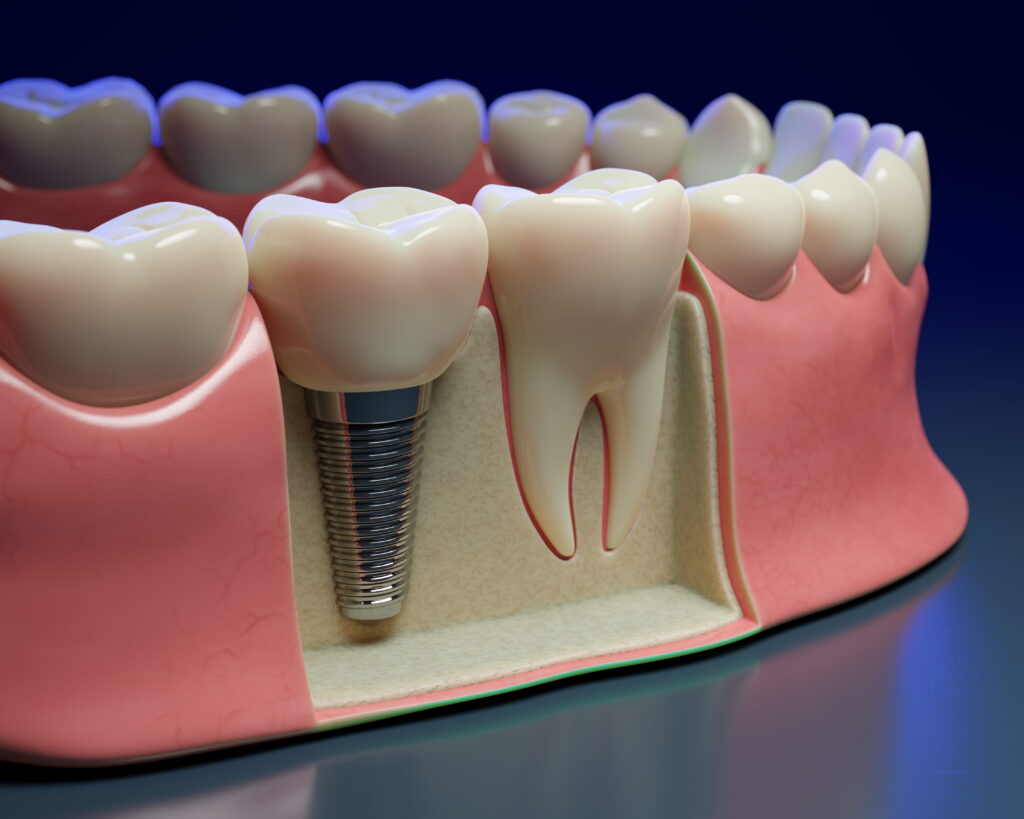
Implants require healthy bone to anchor securely. Over the healing period, the surrounding bone fuses with the titanium implant through a process called osseointegration.
If you don’t have enough bone in your jaw, there may not be enough tissue to support an implant.
If bone volume is insufficient, you might need a supplemental procedure like a bone graft or a sinus lift before an implant can be considered, or you may need to look toward non-implant alternatives, such as removable dentures.
Do You Need a Removable or Fixed Prosthesis?
Patients may prefer whether their replacement teeth are permanently fixed or removable.
- Fixed options, such as implants and bridges, remain in the mouth at all times and are cleaned similarly to natural teeth.
- Removable prostheses, such as partial or complete dentures, are taken out for cleaning and are often removed while sleeping.
Some patients prefer removable options because they generally do not require surgical treatment and may involve shorter treatment timelines. Others may prefer fixed options because they tend to feel more like natural teeth. Among fixed options, dental implants also help preserve jawbone by replacing the tooth root.
Does the Tooth Need to be Replaced or Simply Restored?
Sometimes, a tooth doesn’t need to be replaced. It might be a severely damaged tooth that is still partially present.
If the root of your tooth is still healthy and firmly anchored in the bone, it may not need to be extracted and replaced.
In clinical dentistry, the primary goal is always to preserve natural tooth structure whenever possible. If the tooth has suffered from a deep cavity or a large fracture but the foundation remains solid, a crown might be used to rebuild the tooth.
Extraction followed by complete tooth replacement is reserved for situations in which the tooth cannot be saved by any conservative means.
Do You Want Existing Teeth To Be Altered?
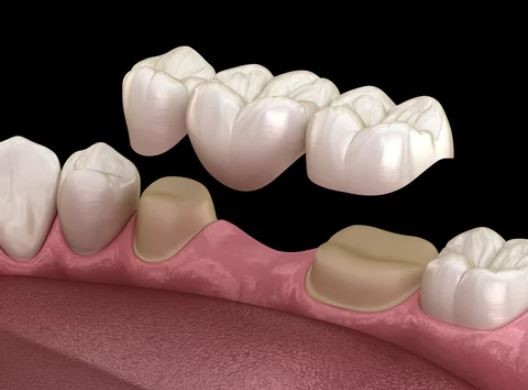
Certain tooth replacement methods require altering the teeth adjacent to the empty space.
For example, a traditional dental bridge relies on the teeth on either side of the gap to act as anchors. To place this bridge, the dentist must prepare or reduce the enamel of these healthy anchor teeth to fit protective crowns.
If you prefer to leave your remaining natural teeth completely untouched, a dental implant is the preferred route. Implants are self-supporting and do not rely on adjacent teeth for stability.
Tooth Replacement Options for a Single Missing Tooth
When only one tooth is missing, the goal is to fill the space while protecting the health of the surrounding structures. There are a few tooth replacement options for this:
Dental Implant
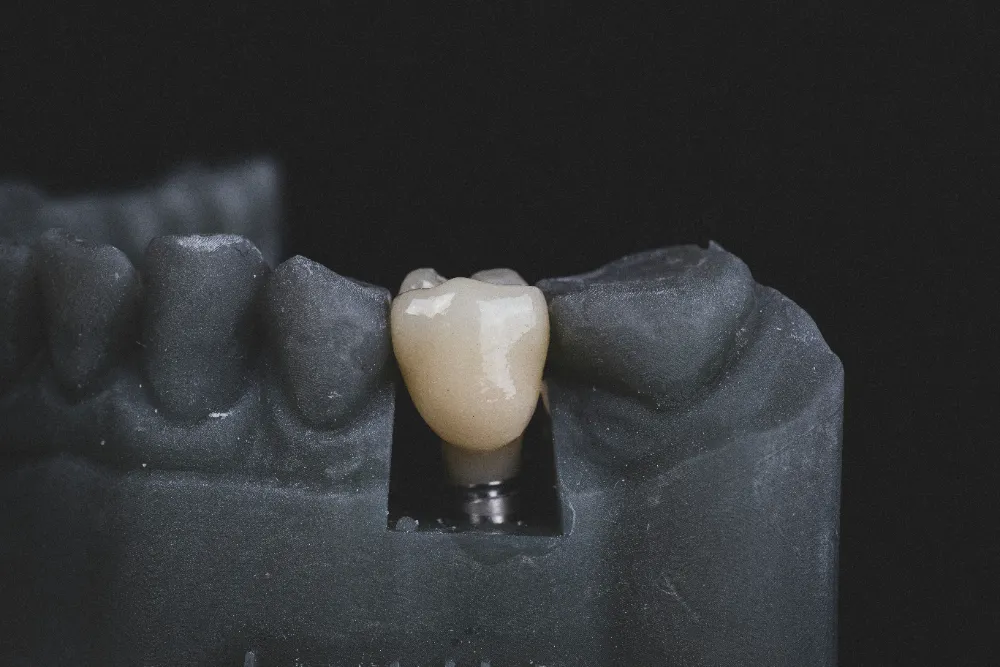
A dental implant is a titanium post surgically placed in the jawbone to serve as an artificial tooth root.
After a healing period of several months, during which the bone fuses to the post, an abutment is attached, followed by a custom-made crown that mimics the visible part of a tooth.
This method provides the patient with a replacement that functions like a natural tooth, and it does not require alteration of the adjacent teeth. It also provides the necessary stimulation to the jawbone to prevent bone resorption.
Bridges Anchored to Existing Teeth
A traditional dental bridge consists of one or more artificial teeth, known as pontics, which are held in place by dental crowns secured to the natural teeth on either side of the space.
This option provides a fixed, stable chewing surface and can often be completed more quickly than implant treatment. However, it requires tooth preparation of the adjacent teeth, which is the permanent reduction of the healthy enamel on the adjacent anchor teeth. This is done so that the anchoring crowns fit snugly onto the adjacent teeth.
Cantilever Bridge
A cantilever bridge is similar to a traditional bridge, but the pontic is supported on only one side by one or more anchor teeth.
This option is used when healthy teeth are only present on one side of the open space.
Maryland Bridge
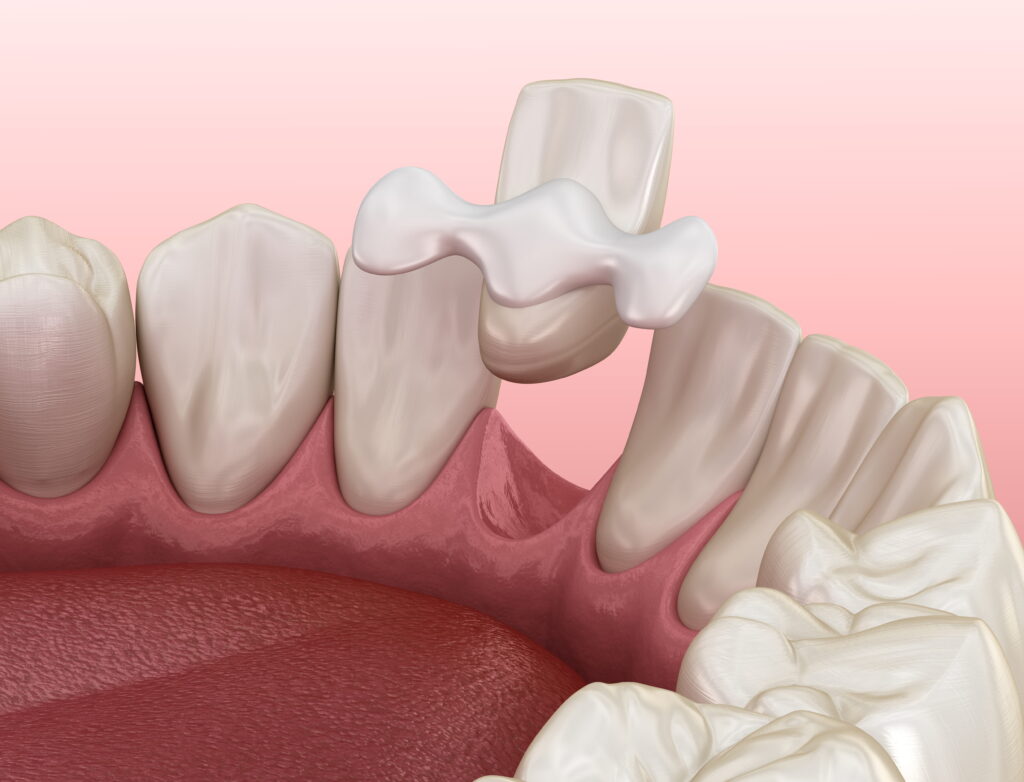
A Maryland bridge, or a resin-bonded bridge, utilises metal or porcelain wings attached to the back of the artificial tooth. These wings are bonded directly to the back surfaces of the adjacent natural teeth.
This option requires minimal preparation or reduction of the adjacent teeth, making it a highly conservative choice. It is primarily used for missing front teeth where the biting forces are relatively light.
Tooth Replacement Options for Multiple Missing Teeth
If you are missing multiple teeth but still have several healthy, natural teeth remaining, the following options can help restore function to your mouth:
Removable Partial Dentures
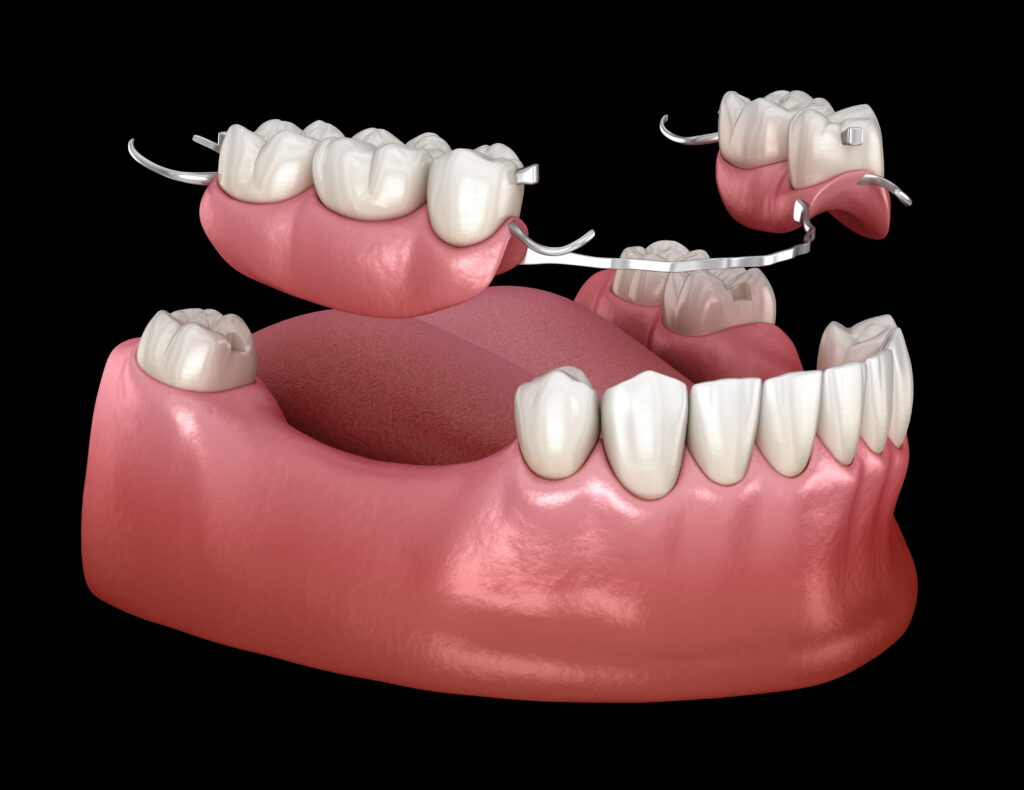
A removable partial denture consists of replacement teeth attached to a pink or gum-colored plastic base, which is sometimes supported by a metal framework that holds the denture in place inside the mouth.
These dentures often utilise metal or tooth-colored clasps that hook onto your natural teeth for stability.
They are adaptable and can replace multiple missing teeth in different areas of the same arch.
Bridges Anchored to Existing Teeth
For patients missing two or more teeth in a direct row, a longer dental bridge can be fabricated.
Just like a single-tooth bridge, it uses the natural teeth at the ends of the empty space as anchors to hold a continuous line of replacement teeth.
Bridges Anchored to Implants
If you are missing multiple adjacent teeth and do not have strong natural teeth available to act as anchors, or if you wish to avoid altering your existing teeth, an implant-supported bridge may be used.
In this scenario, implants are placed at the ends of the gap, and a bridge is secured on top of them, spanning the space without involving natural teeth.
Tooth Replacement Options for Those Without Existing Teeth
For patients who have lost all their natural teeth in the upper or lower jaw (also known as full-arch edentulous patients), the goal is full-arch rehabilitation to restore basic life functions such as eating and speaking.
Restorative options for these patients include the following:
Full Removable Dentures
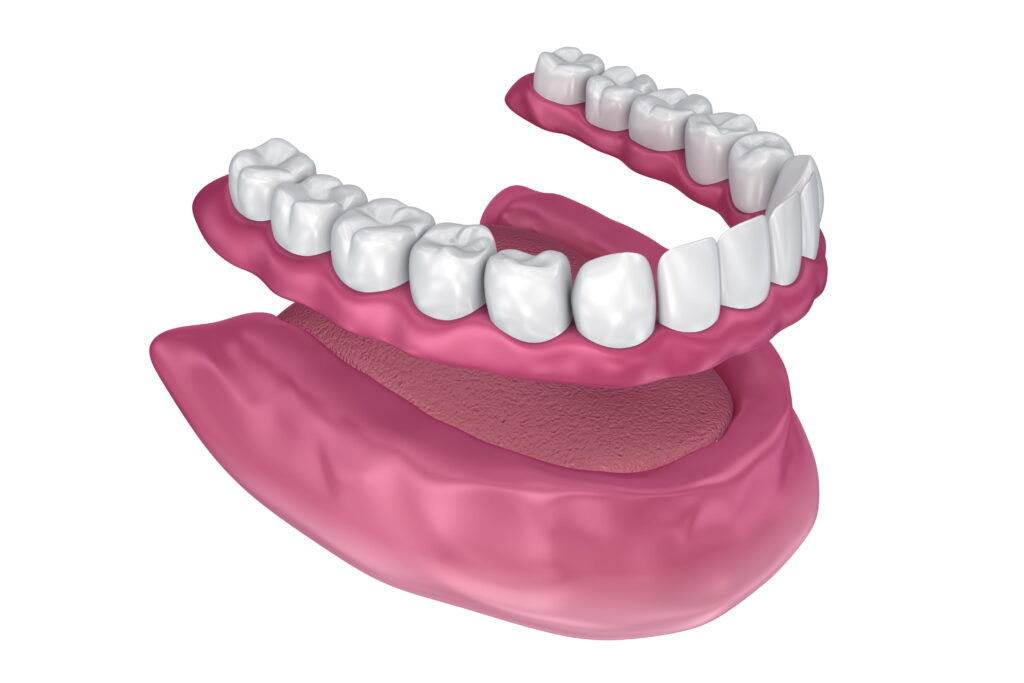
Full dentures are a complete set of artificial teeth attached to a base that rests over the gums.
They are custom-made to fit your mouth, and their retention may come from the fit of the denture itself and, in some cases, denture adhesive.
While they are a common non-surgical option for replacing all teeth, some patients may find that full dentures feel less stable during eating or speaking than fixed alternatives.
All-on-4
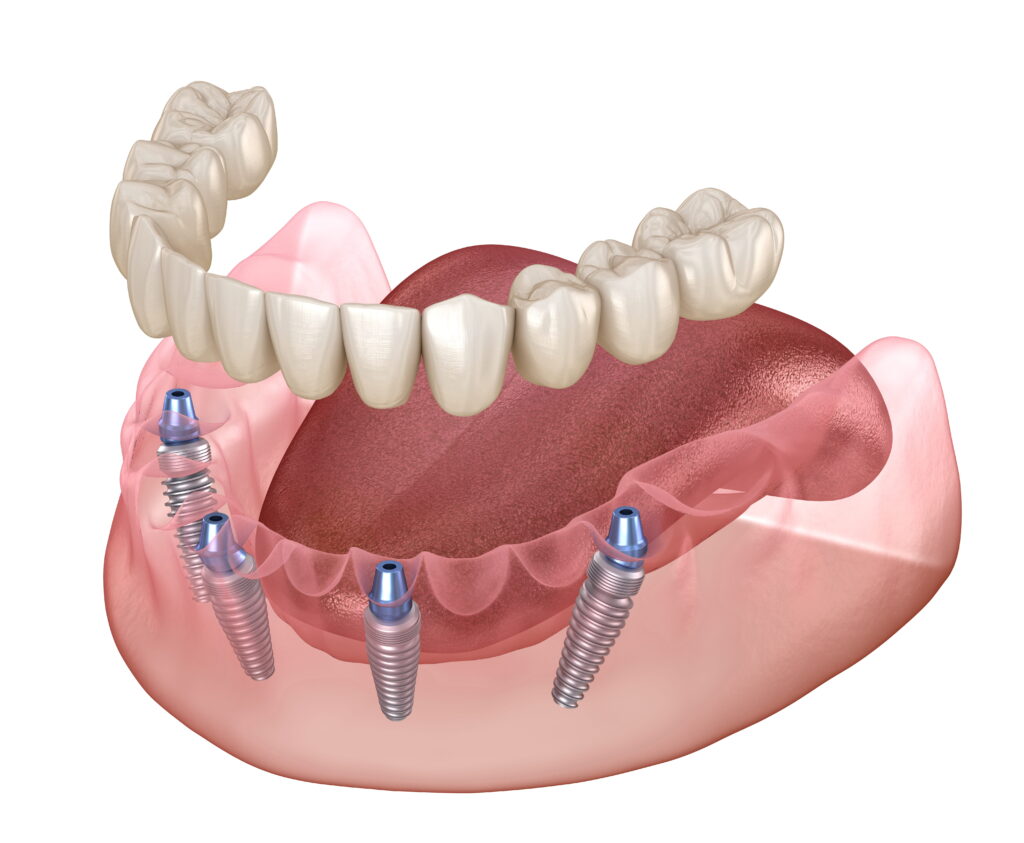
The All-on-4 method is an implant treatment in which a full arch of replacement teeth is supported by four strategically placed dental implants.
This approach is designed to make efficient use of available bone and provide a fixed alternative to removable dentures. For suitable patients, it can offer improved stability for chewing and speaking compared with removable options.
All-on-4 or All-on-6 treatment may involve careful planning, multiple appointments, and a staged workflow, depending on the patient’s oral condition and the treatment protocol used.
Tooth Replacement Options for Those Restoring a Severely-Damaged Tooth
Not all damaged teeth need to be extracted. In many cases, clinical intervention can save the natural root.
Crowns
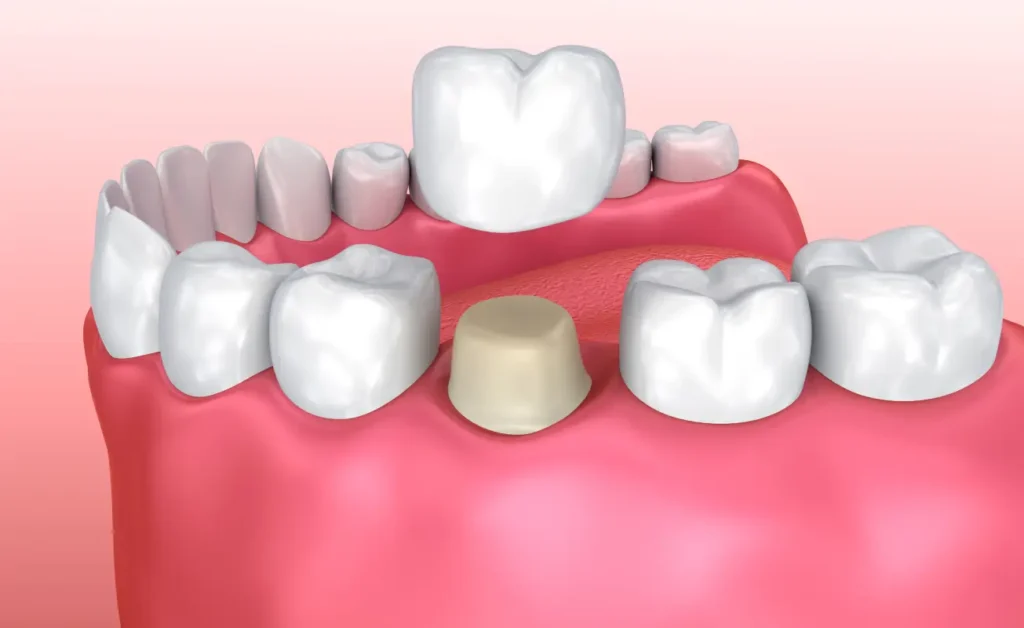
A dental crown is a custom-fitted cap that covers the entire visible portion of a tooth above the gum line.
If a tooth is severely cracked, broken, or weakened by extensive decay or a root canal, a crown is placed to protect the remaining tooth structure and restore its full function.
Find a Tooth Replacement Option that Suits Your Needs!
Evaluating the health of your smile and choosing the most appropriate treatment requires careful planning and a proper clinical assessment.
At Elements Dental, we take the time to understand your concerns, assess your oral condition, and explain the treatment options that may be suitable for your needs.
Whether you are missing a single tooth or exploring full-arch rehabilitation, the right solution depends on factors such as your oral health, bone support, and treatment goals.
If you are considering tooth replacement, schedule a consultation with our dentist to discuss the options appropriate for your case.
Frequently Asked Questions
Will my insurance plan cover the cost of a tooth replacement?
Coverage varies significantly across providers and plans; however, many insurance schemes cover restorative treatments like bridges or dentures, though implants may sometimes be classified differently.
Is it painful to undergo a tooth replacement procedure?
Clinical practitioners use local anaesthesia to ensure you remain comfortable during the procedure, and any post-treatment tenderness can typically be managed with standard over-the-counter pain relief medication.
How do I clean and maintain a fixed dental bridge?
A fixed bridge is cleaned much like natural teeth, through brushing, though you will need to use specialised floss threaders or interdental brushes to clean the area under the artificial tooth.
What is the typical lifespan of a removable partial denture?
With proper care and routine clinical adjustments, a partial denture generally lasts between five and seven years before the base or the underlying bone structure changes enough to require a replacement.
What happens if I choose not to replace a missing back tooth that isn’t visible?
Even if the gap is not visible, leaving a missing tooth untreated can contribute to gradual bone loss in that area and may affect neighboring or opposing teeth over time.
Whether replacement is recommended depends on factors such as the tooth’s location, your bite, and your overall oral health, so it is best to discuss the long-term implications with your dentist.